
The right pond pump needs to move enough water for the job at the height it will be working. The largest flow figure on the box is only part of the picture.
Use our calculators to work through pond volume, circulation and water-feature flow. The guide below explains the measurements to have ready. For the manual examples we use metres; in each calculator, follow the units shown beside its fields.
1. Work out your pond volume
Pond volume helps you plan circulation and filtration. Measure the water, not the outside of the pond walls. Take depth readings in several places and use a representative average, allowing for shelves and sloping sides.

Round ponds
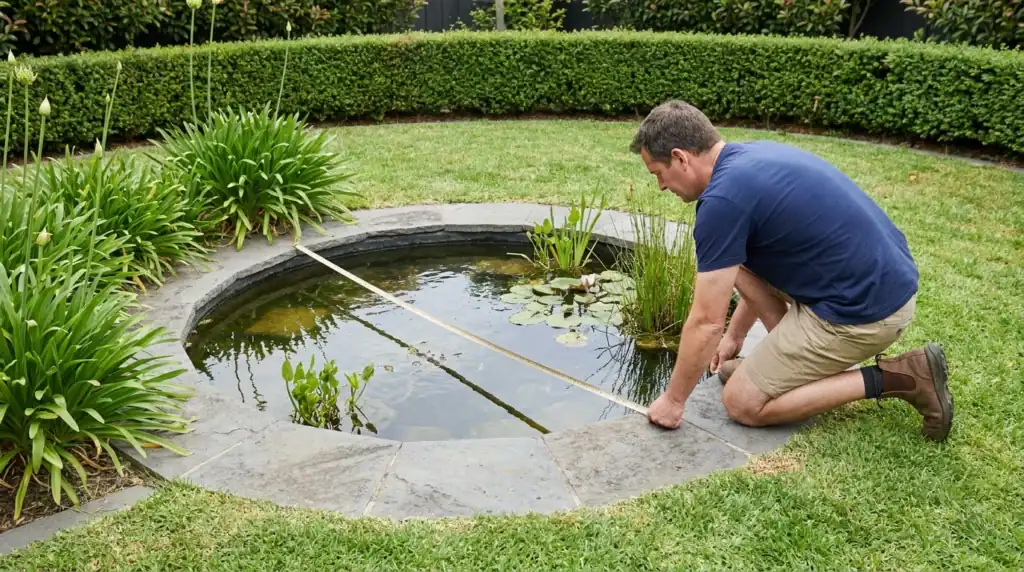
Measure all the way across the centre to get the diameter. Divide it by two to get the radius.
Volume in litres = 3.1416 × radius × radius × average depth × 1,000
For a round pond 2 m across and 0.6 m deep on average, the radius is 1 m. Its volume is 3.1416 × 1 × 1 × 0.6 × 1,000, or approximately 1,885 litres.
The width arrow in the illustration shows the diameter, so halve that measurement before using the formula.
Square and rectangular ponds
Volume in litres = length × width × average depth × 1,000
A pond 3 m long, 2 m wide and 0.5 m deep on average holds 3 × 2 × 0.5 × 1,000 = 3,000 litres.
Irregular ponds
Divide the pond into simple sections and estimate each section’s volume separately, using an average depth for that section. Add them together. This gives a practical estimate, not an exact measurement of an uneven pond.
2. Measure the lift and note the pipework
For a waterfall or raised outlet, measure the vertical distance from the pond’s normal water surface to the highest discharge point. This is the static lift. Do not measure from the pump or the bottom of the pond.
Also note the hose or pipe size, its length and the fittings along the route. These create resistance, so the pump needs to overcome more than the vertical lift alone. A long horizontal run does not add height, but its friction losses still affect delivery.
A pump’s maximum flow and maximum head are different ends of its performance range. It will not deliver its maximum flow at its maximum head. Check the flow available at the working head using the manufacturer’s performance chart, including the pipework losses.
3. Check the flow your water feature needs
A water feature needs enough flow to produce the effect you want, not simply enough to turn over the pond volume.
For a spillway, measure the width of the lip the water flows over. For a bowl spilling around its whole rim, use the full circumference, not its diameter. A partial spill opening needs its actual opening width rather than the whole rim.

The following are the starting figures used in this guide for two different effects:
- Water staying close to the wall: 5 L/min for each 10 cm of spilling edge.
- A projecting blade of water: 16.66 L/min for each 10 cm of spilling edge.
For example, using the first starting figure, a 60 cm edge gives 6 × 5 = 30 L/min, equivalent to 1,800 L/h.
These are guides to an effect, not universal minimums for every spillway or fountain. Drop height, the outlet’s construction and the desired sheet of water all matter. Use the feature manufacturer’s specified flow where available and check it against the pump’s delivery at the working head.
4. Match the pump to the whole job
Have your pond volume, intended use, feature measurements and pipework details ready when using the pump calculator.
- For circulation and filtration: the pump and filter must suit the pond, fish load and each other’s operating limits. More flow is not automatically better if it exceeds the filter’s rating.
- For a waterfall or fountain: check the required delivery at the outlet’s working height, not just the pump’s headline flow.
- For a combined setup: check how water is routed through the filter and feature. Do not automatically add their requirements if the same water passes through both.
Our pond pump buying guide explains the main pump types if you are still deciding what suits the application.
Choosing the right output helps avoid a disappointing trickle at a water feature or inadequate circulation. Pump sizing is one part of a healthy pond; appropriate filtration, maintenance and pond conditions also matter.
Use the calculators to prepare your measurements, then browse our pond pumps and compare their published performance with your requirements.
When comparing options, look at the individual performance charts for ranges such as Reefe pond pumps, or explore the Oase range. Choose the model that meets your measured requirements, rather than choosing by brand or maximum flow alone.
Last updated: 11 November 2026